
Why Discipline Beats Motivation
For a long time, I thought motivation was the key to success.
I believed motivated people were the ones who stayed consistent, achieved their goals, and pushed themselves further than everyone else. But over the years, especially through high-stress environments in both the military and project management, my perspective completely changed.
I realized you can have all the motivation in the world, but without discipline, it usually does not lead anywhere.
Some things in life will never feel motivating. Nobody wants to have difficult conversations, explain major problems to stakeholders, admit mistakes, or deal with stressful situations that could easily be avoided. There are moments where you simply will not feel inspired or excited to do what needs to be done.
That is where discipline takes over.
Discipline is what forces you to act even when you do not feel like it. It removes the option of avoiding responsibility. In my own life, I’ve learned that real growth usually comes from doing the hard things you would rather avoid.
Over time, I started realizing that discipline showed up most during stressful situations, not easy ones. In both the military and project management, I’ve had moments where I needed to address difficult problems immediately even when I wanted to avoid them completely. Having uncomfortable conversations, delivering bad news, owning mistakes, or handling pressure are rarely things anyone feels motivated to do.
But avoiding those situations almost always makes them worse.
I learned that discipline is often about removing the option to avoid responsibility. Sometimes the right thing to do is uncomfortable, stressful, and mentally exhausting, but doing it anyway is what builds resilience and growth over time.
Motivation comes and goes constantly. Some days you feel focused and energized, while other days you feel stressed, overwhelmed, mentally drained, or completely unmotivated. If your progress depends entirely on motivation, consistency becomes almost impossible.
That’s why discipline matters so much more long term. Consistency is usually what separates short bursts of excitement from real lasting growth.
“Discipline is the bridge between goals and accomplishment.”
– Jim Rohn
Why Motivation Usually Fails
I think one of the biggest misunderstandings people have about motivation is believing they need to feel excited before they take action.
A lot of people spend time trying to “get motivated” before they start improving their lives. They watch videos, listen to podcasts, scroll social media, or wait for the perfect moment to suddenly feel inspired.
The problem is that motivation is emotional, and emotions constantly change.
There are many things in life you will probably never feel motivated to do. Nobody wakes up excited to have uncomfortable conversations, own up to mistakes, deal with failure, or handle stressful situations. But those are usually the moments that shape people the most.
Real growth often happens when you do something difficult despite not wanting to do it at all.
That is why discipline matters more. Discipline allows you to continue moving forward regardless of how you feel that day.
Discipline Builds Self-Trust
One thing I’ve realized over time is that discipline builds resilience and trust in yourself.
Every time you force yourself to do something difficult, especially when you do not feel like doing it, you prove to yourself that you are capable of handling discomfort, stress, and responsibility. Over time, that changes the way you view yourself.
You stop relying on emotion and start relying on consistency.
I think a lot of confidence actually comes from self-trust. When you consistently show up for yourself, keep promises to yourself, and continue doing hard things even when they are uncomfortable, you start believing in your own ability to handle challenges.
That creates resilience.
You begin to understand that difficult moments are temporary and that you are capable of pushing through them instead of avoiding them. To me, discipline is not about punishment or forcing yourself to suffer constantly. It is about building a version of yourself that you can genuinely trust and rely on.
You have to become your own biggest supporter.
Growth becomes much easier when you stop waiting for motivation and start trusting yourself to continue improving regardless of how you feel that day.
The Small Habits Matter Most
I think people underestimate how much small habits shape their lives over time.
One rule I personally try to follow is simple: if something takes less than five minutes, just do it. Five minutes is nothing.
Whether it’s replying to an email, making a difficult phone call, cleaning something up, or handling a responsibility you keep avoiding, it usually feels worse delaying it than actually doing it. The longer you avoid small difficult tasks, the heavier they become mentally.
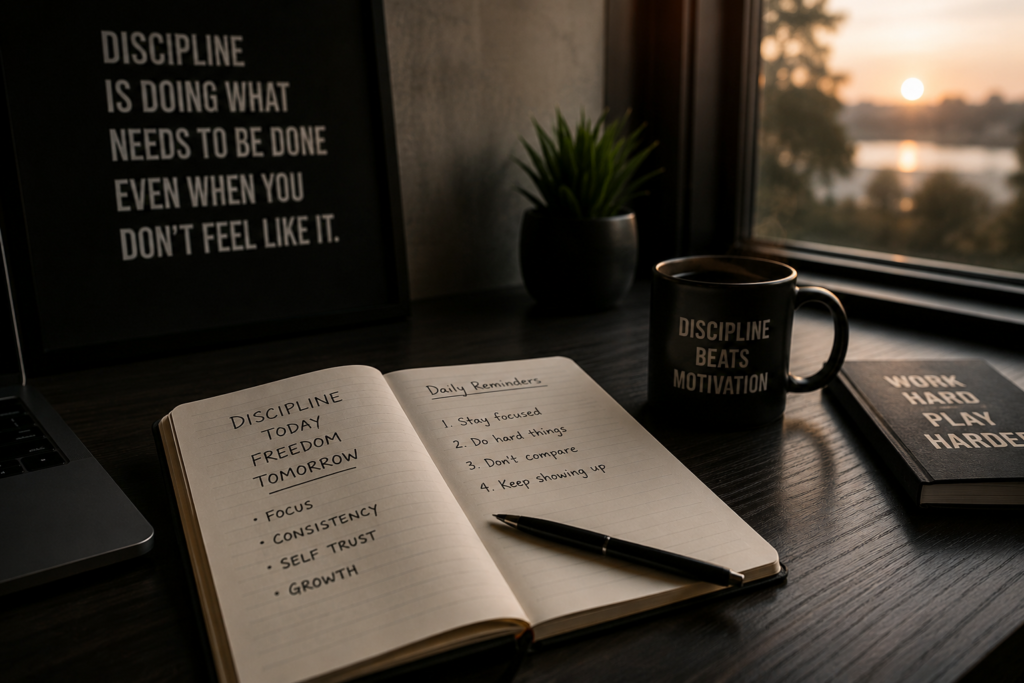
Discipline is often built through these tiny moments that nobody else sees, not through giant motivational breakthroughs.
One habit that has personally helped me build discipline is fasting. Most days I fast from around 7 PM until noon the next day. I genuinely love food, and if I’m not careful, I can easily overeat or constantly snack throughout the day. Fasting helps create structure and self-control for me personally.
What I’ve noticed is that the habit itself matters just as much mentally as it does physically.
There are plenty of times where I want to eat outside of my fasting window, especially during stressful days or late at night. But staying disciplined with it reminds me daily that I am capable of controlling impulses and sticking to commitments I make to myself.
I think discipline grows through small repeated actions like that. Not because they are extreme, but because they reinforce consistency and self-control over time.
Balance Matters Too
I also think people misunderstand discipline as constantly pushing yourself to the limit with no breaks.
I do push myself hard, but I also believe mental health and recovery are extremely important. No matter how stressful life gets, I always try to make time for family, friends, and the things I genuinely enjoy. The phrase “work hard, play harder” honestly stays in the back of my mind a lot.
I’ve noticed that even during stressful periods, if I force myself to take a little time to relax, reset mentally, or spend time doing something I enjoy, I usually come back feeling much stronger and more focused.
Sometimes when people feel overwhelmed or mentally drained, they stop doing the very things that would actually help them feel better. I’ve experienced that myself.
There are times when I do not feel like working out, being social, or doing activities I normally enjoy. But I’ve learned to force myself to do those things anyway because deep down I know I’ll feel better afterward.
How to Stay Fit With a Full-Time Job: Why Discipline Beats MotivationDiscipline is not only about forcing yourself to work harder. Sometimes discipline is forcing yourself to recover properly too.
Stop Comparing Yourself to Everyone Else
I honestly think comparison is one of the biggest reasons people struggle mentally today, and I catch myself doing it too sometimes.
Social media makes it easy to believe everyone else is happier, more successful, more disciplined, or further ahead in life than you are. But most of the time people are only showing the highlights of their lives.
Everyone struggles.
Everyone deals with stress, insecurity, pressure, setbacks, and failure in some way.
I think people become much happier when they stop obsessing over what everyone else is doing and focus more on improving themselves little by little every day. Small improvements matter. Progress matters.
The goal is not to become perfect overnight. The goal is to continue growing steadily over time.
Final Thoughts
Motivation can help you start, but discipline is what keeps you going when life becomes stressful, uncomfortable, or difficult.
Real growth usually comes from continuing to show up even on the days you do not feel like it. That applies to fitness, work, relationships, mental health, and life in general.
You do not need to feel motivated every day.
You need routines, habits, and standards that continue working even when motivation fades. That is what creates long-term growth.
Pace your purpose. Drive your future.