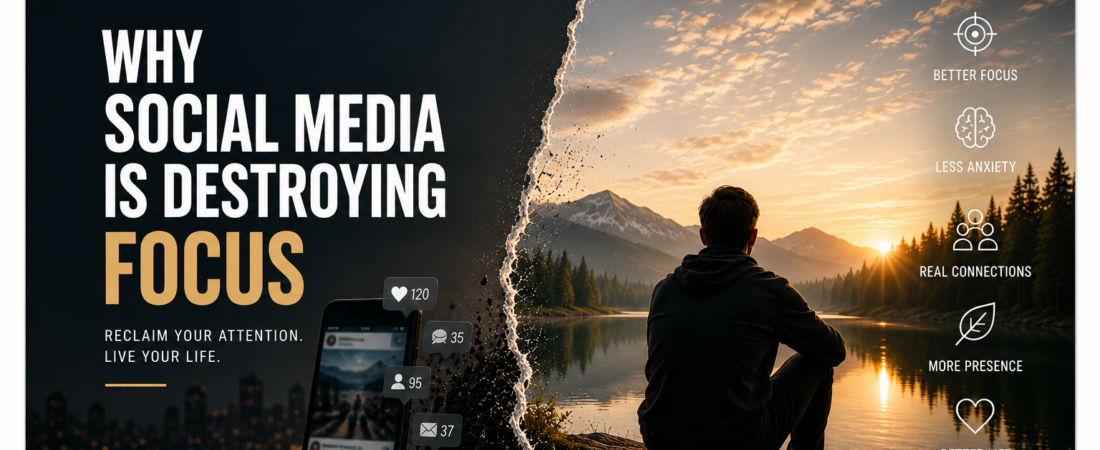
I think one of the biggest problems in modern life is that people can no longer focus deeply on anything for very long.
Social media, notifications, constant stimulation, and endless scrolling are quietly destroying attention spans and increasing anxiety in ways most people do not even realize.
I’ve struggled with this myself too.
At different points in my life, social media has:
- ruined my focus,
- wasted huge amounts of time,
- increased anxiety,
- and completely destroyed my attention span.
And honestly, I think a lot of people underestimate how dangerous that really is.
Attention Is Being Pulled in Every Direction
Modern life constantly fights for our attention.
Notifications.
Messages.
Emails.
Videos.
Short-form content.
Breaking news.
Social media feeds.
Algorithms designed to keep us scrolling endlessly.
Our brains never truly get a break anymore.
I think one of the biggest reasons people feel mentally exhausted today is because their attention is constantly fragmented throughout the day. We rarely focus fully on one thing before something else pulls us away mentally.
Over time, that constant overstimulation slowly damages our ability to think deeply, stay present, and focus intentionally.
A lot of the mental exhaustion people experience today comes directly from constant stimulation, fragmented attention, and decision fatigue. I talk more about that in my article on why modern life feels mentally exhausting.
Social Media Speeds Up Life
One realization that really changed my perspective happened when my wife and I rented a cabin in the woods for a few days with no cell service.
No social media.
No notifications.
No constant stimulation.
No technology.
Just silence, nature, conversations, reading, and being present.
When we came back home, I realized how much social media speeds up life.
Everything suddenly felt loud again.
Fast.
Overstimulating.
Constant.
And honestly, it made me realize how often we spend our lives mentally rushing toward the next thing instead of appreciating the moment we are currently living in.
Sometimes I feel like I’m constantly chasing something better, faster, or bigger. But then I look back on past periods of life and think:
“Those were the good times.”
The strange part is that while living through those “good times,” I was usually too distracted or mentally focused on the future to fully appreciate them in the moment.
That realization honestly changed the way I look at presence and intentional living.
Comparison Is Quietly Destroying Perspective
I think social media has also created completely unrealistic expectations for success, happiness, fitness, relationships, and life overall.
Everyone shows:
- the best moments,
- the best photos,
- the best accomplishments,
- the best vacations,
- and the best parts of their lives.
We compare our normal everyday lives to someone else’s highlight reel.
The problem is that even people who appear to have “perfect” lives online are often dealing with the exact same things we are:
- stress,
- anxiety,
- burnout,
- insecurity,
- loneliness,
- and comparison.
Social comparison is heavily studied at this point, and I genuinely believe it’s one of the biggest contributors to anxiety and dissatisfaction in modern society.
Doom Scrolling and Dopamine
I think one of the hardest parts about social media is how addictive it becomes.
Your brain naturally craves the dopamine hits from:
- scrolling,
- checking notifications,
- refreshing feeds,
- and consuming endless short bursts of stimulation.
The problem is that the stimulation never really satisfies you long term.
It just keeps your brain craving more.
I started realizing how much doom scrolling negatively affected my mood, focus, and mental clarity over time. Eventually I became much more intentional about limiting notifications and reducing quick access to social media apps.
One thing I noticed personally is that notifications remove some of the guilt associated with checking social media.
If a notification pops up, it almost feels like you were invited to check your phone.
But when I physically have to stop what I’m doing, unlock my phone, search for the app, and intentionally open it myself, I immediately become more aware of what I’m doing and why I’m doing it.
That awareness alone helped me reduce a lot of unnecessary scrolling.
Presence Feels Different
One of the biggest things I’ve noticed since reducing social media usage is how much calmer and more present I feel overall.
I feel more focused.
More intentional.
Less anxious.
Less mentally scattered.
I’ve also realized that mental recovery becomes almost impossible when your brain is constantly overstimulated. That’s a huge part of why recovery is part of discipline long term.
And honestly, I appreciate conversations with people much more now too.
To me, being truly present means listening to understand someone instead of simply waiting for my turn to respond while thinking about something else in my head.
That kind of presence feels rare today.
Silence also became much more important to me over time.
I think people underestimate how mentally healthy it is to sit quietly, listen to nature, and allow your brain to slow down without constant stimulation being forced into it every second.
Discipline and Self-Awareness Matter
At the end of the day, I think reducing social media comes down to discipline and self-awareness.
Once I truly started paying attention to how social media affected my:
- focus,
- mood,
- anxiety,
- and mental clarity,
it became easier to care enough about myself to create healthier boundaries around it.
A lot of improving habits like this comes down to discipline rather than temporary motivation. I dive much deeper into that idea in my article on why discipline beats motivation.
That does not mean I never use social media anymore.
It just means I became much more intentional about how often and why I use it.
I think a lot of people know social media negatively affects them mentally, but they never fully slow down long enough to honestly acknowledge how much it impacts their daily lives.
Final Thoughts
I do not think social media is entirely bad.
But I do think constant overstimulation, comparison, notifications, and fragmented attention are quietly damaging people’s mental health and ability to stay present.
Modern life already moves fast enough.
We do not need endless stimulation speeding it up even more.
I think one of the most valuable things people can do today is intentionally slow down:
- protect their attention,
- reduce unnecessary stimulation,
- focus deeply,
- and become more present in their actual lives.
Because at the end of the day, attention is one of the most valuable things we have.
And the things we consistently give our attention to eventually shape the quality of our lives.